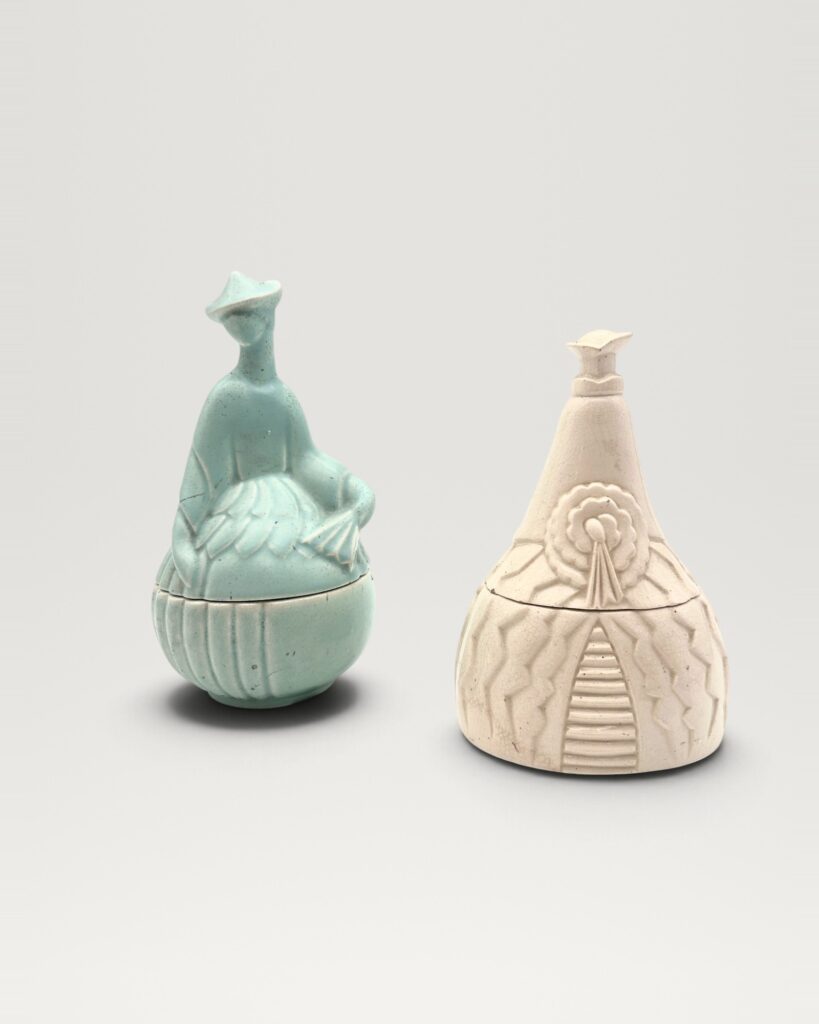
Two covered boxes in glazed ceramic, white and celadon, Claude Lévy (1895-1941) for Primavera, 1920s-1930s
- Date
- 1920s-1930s
- Dimensions
- H. 22 cm (white H. 18, W. 12 cm; celadon H. 22, W. 11.5 cm)
On view at the showroom, 1 rue des Bons Enfants, Marché L'Usine, stand 3, 93400 Saint-Ouen. Delivery in France and worldwide.
Download the sheet (PDF)Two covered boxes in glazed ceramic, one white with Art Deco decoration in relief, the other celadon
Claude Lévy for Atelier Primavera
‘Primavera France’ mark under the base
1920s-1930s
White: H. 18, W. 12 cm
Celadon: H. 22, W. 11.5 cm
About Claude Lévy
Born Germaine Lévy in Nantes in 1895, Claude Lévy was a painter and decorative artist. A pupil of her cousin Lucien Lévy-Dhurmer, she exhibited at the Salon des Indépendants from 1922 to 1929 and at the Salon d'Automne.
At the 1925 International Exhibition of Decorative Arts she won several medals and a grand prix, and the Blumenthal prize honoured her in 1928. A painter of flowers, portraits and landscapes, she also created ceramics, notably vases. She died in Paris in 1941.
About Primavera
Founded in Paris in 1912, Primavera was the art studio of the Grands Magasins du Printemps. It grew out of a partnership between René Guilleré, a lawyer and one of the founders of the Société des artistes décorateurs, and Pierre Laguionie, then head of Printemps. Its principle was to design and produce modern furniture and objects in small series, sold in the store at affordable prices.
Artistic direction was entrusted to Charlotte Chauchet-Guilleré. She called on young designers, among them Louis Sognot, Marcel Guillemard, Madeleine Sougez and Claude Lévy. At the 1925 Exposition internationale des arts décoratifs et industriels modernes, the studio had its own pavilion. The architects Henri Sauvage and Georges Wybo designed it, and she was responsible for its interior.
Ceramics became one of the house's favoured fields. In 1920 Primavera acquired a workshop at Sainte-Radegonde, near Tours, and worked with other manufacturers, notably the Céramique d'Art de Bordeaux and the Longwy faience works. Colette Gueden joined the studio in the 1930s and led its final decades, until production ceased in 1972. Alain-René Hardy devoted a monograph to its history, published in 2015.
Shipping and packing
Custom packing and insured shipping, in France and worldwide. Quote on request.