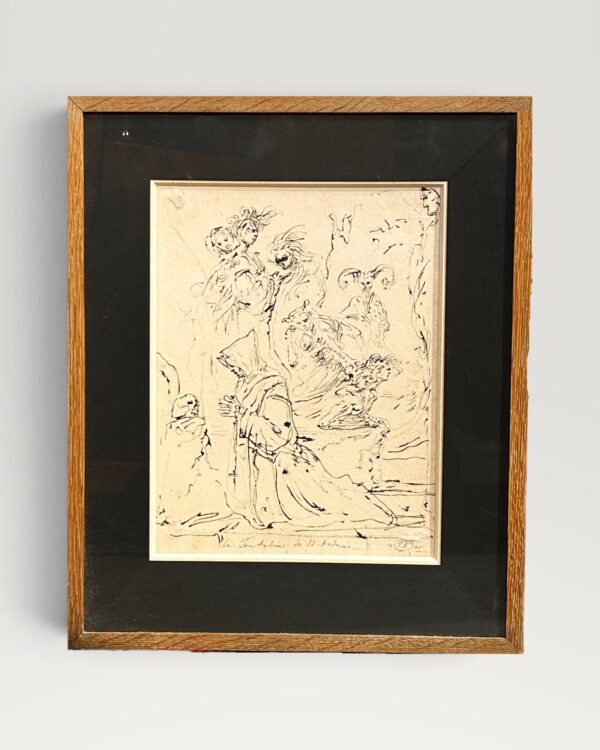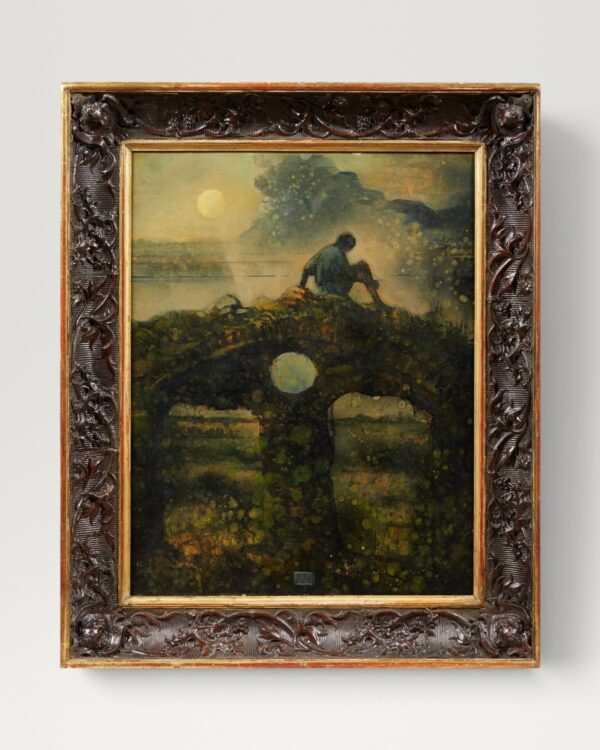

Eugène Berman
Born in Saint Petersburg on 4 November 1899, Eugène Berman studied painting and architecture in Russia from 1914. He left for Paris in 1918, where he attended the Académie Ranson and studied under Vuillard and Maurice Denis.
In 1926 he exhibited at the Galerie Druet with his brother Léonide and Pavel Tchelitchew; the critic Waldemar George described this circle, which also included Christian Bérard, as neo-romantic. Influenced by Giorgio de Chirico and by his stays in Italy, he painted deserted landscapes filled with ruins. Shown in New York by Julien Levy from 1932, he settled in the United States in the late 1930s and devoted himself increasingly to the stage: Devil's Holiday for the Ballet Russe de Monte Carlo (1939), Così fan tutte for the Piccola Scala (1956) and Don Giovanni for the Metropolitan Opera (1957). The Museum of Modern Art exhibited his theatre work in 1947.
After the death of his wife, the actress Ona Munson, in 1955, he moved to Rome, to the Palazzo Doria Pamphilj. He died there on 14 December 1972, bequeathing his collection of antiquities to the Italian State. His work is held by the Metropolitan Museum of Art and MoMA.